What To Do When Your Child Breaks Things
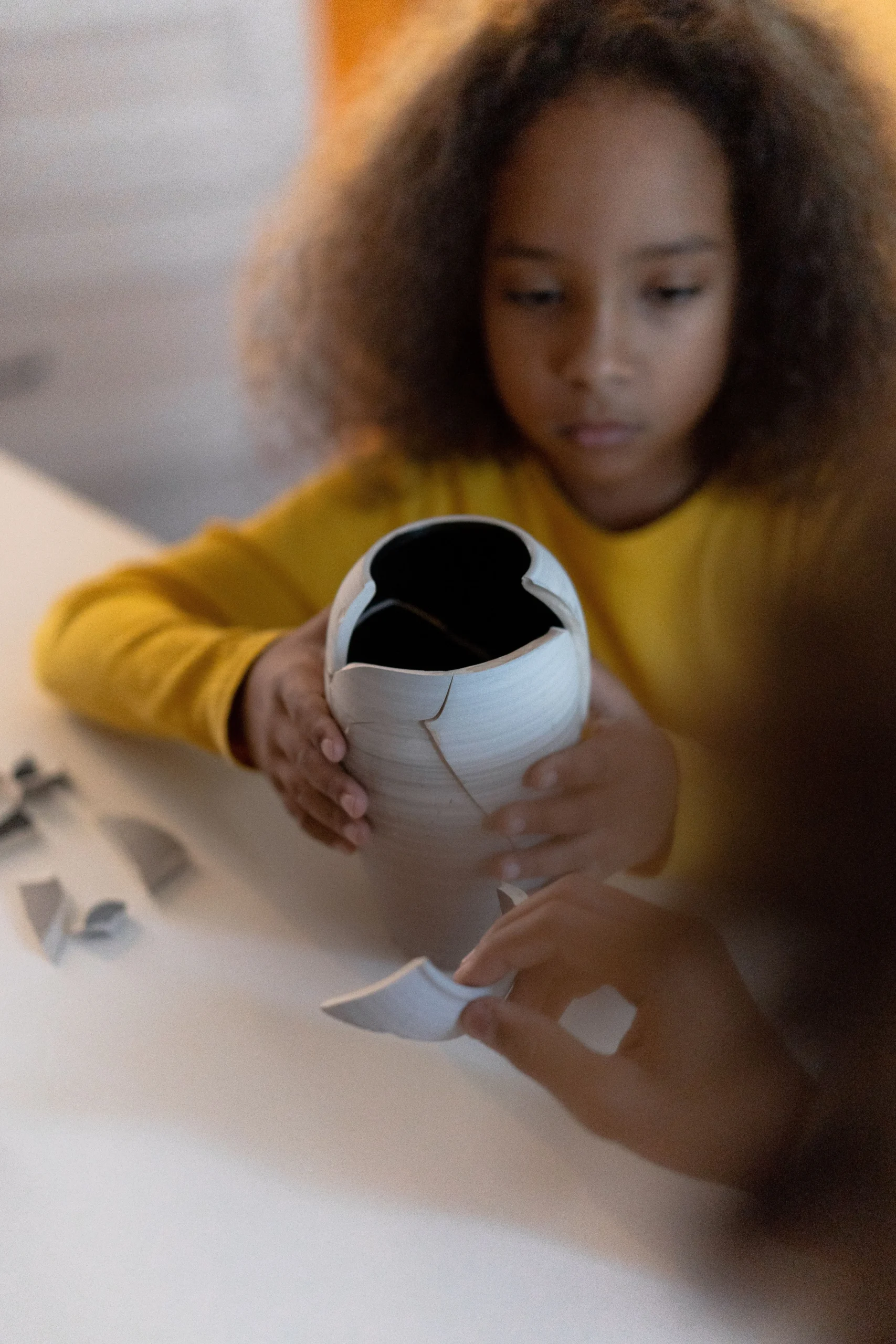
What this article will help you do
If your child breaks things when they’re angry, upset, frustrated, or overwhelmed, this article will help you in the moment without making the pattern harder to change.
You’ll learn what to do, assess how serious the damage may be, learn what to say, avoid, and how to handle consequences, as well as how to start teaching your child a safer way to communicate.
This article isn’t about blaming you or your child, it’s about helping you move from panic, shouting, or damage control to a clearer pattern: safety first, fewer words, steady boundaries, repair when calm, and better replacement skills.
Quick summary
When your child breaks something, the first thing to prioritise is safety.
Not a lecture, not punishment and not working out who is to blame. The first thing to do is to make the situation safer.
Use fewer words, move dangerous items, keep people away from harm, and avoid giving the situation more power than it already has.
As a first response, you might want to:
- Check safety.
- Move people, pets, sharp objects, or breakable items away.
- Use a brief sentence.
- Avoid changing boundaries just because something was broken.
- Prompt a safer response, for example: “help”, “break”, “space”, “I’m angry”, or “too much”.
- You can come back to repairing, cleaning up, or practising replacement skills later, once everyone is calm enough.
- Track the pattern so you know what might be connected to the behaviour.
If you are unsure which part of the pattern to focus on first, a free 25-minute Behaviour Clarity Session can help you describe one repeated situation and identify a sensible next step.
For parents, focused on one behaviour in one home routine. No preparation or expectation to buy further support. Book with your name and email; we’ll guide you through consent and brief checks at the start of the call. Session information · Privacy.
If your child is breaking things right now
Start here: you don’t need the perfect response, you just need a safe one.
Try this:
- Move people first – if siblings, pets, or adults could be hurt, create space.
- Remove dangerous items – glass, sharp objects, heavy objects, electronics, or anything that could cause injury.
- Use a brief sentence, e.g. “I’m keeping everyone safe.”
- Try not to argue over the broken item in the heat of the moment. The lesson can come later.
- Maintain any boundaries – if the answer was no, it’s still no. If the task still needs to happen, it still needs to happen, although you may make the first step smaller.
- Prompt a safer response, e.g. prompting to say: “Help.” “Break.” “Space.” “I’m angry.” “Too much.”
- Return to repair once your child is calm enough. Repair might mean cleaning safely, helping fix something, apologising, making a plan, replacing something where realistic, or practising what to do next time.
Here’s a simple script:
“I won’t let anything else get broken. I’m moving this away.”
If something has already broken, say:
“Something has broken. I’m keeping everyone safe now.”
If there is a boundary:
“The answer is still no. You can say, ‘I’m angry’.”
If there is a task:
“This still needs to happen. You can say, ‘help please’.”
If your child is overwhelmed:
“This is too much. We’re making it safer.”
That’s enough for the first moment.
How serious is the breaking?
Not all property damage needs the same response.
Snapping a pencil isn’t the same as smashing glass, throwing a heavy object, or breaking a sibling’s treasured item.
Here’s a guide you can use:
| Level | What it may look like | What to do first |
|---|---|---|
| Lower risk | Snapping pencils, ripping paper, breaking low-risk toys, throwing soft items | Stay calm, reduce words, prompt a safer response, repair later |
| Moderate risk | Throwing toys, damaging belongings, breaking sibling items, knocking things over | Create space, protect others, keep the boundary steady, return to repair when calm |
| Higher risk | Glass, doors, windows, screens, furniture, heavy objects, throwing near people | Prioritise safety, remove access where possible, make a safety plan, seek extra support sooner |
| Urgent risk | Injury, weapons, serious threats, fire-setting, or you cannot keep people safe | Get immediate help. If there is immediate danger, contact emergency services |
This isn’t about panicking, but it is about matching your response to the level of risk.
A low-risk broken pencil may just need a calm repair routine and teaching a better way to ask for help.
A smashed window or thrown heavy object needs a focused safety plan and extra support.
If something is already broken
There may be times where you aren’t trying to prevent the damage, but instead find yourself standing in the room after something has already been smashed, snapped, ripped, cracked, or thrown.
And in that moment, try to separate safety clean-up from teaching.
1. Move people away from danger
If there’s glass, sharp plastic, broken electronics, heavy items, or anything unsafe, move your child, siblings, pets, and yourself away
2. Don’t ask your child to clean dangerous items
Your child can still take part in repair later, in a safe way.
3. Keep your words short
This may not be the best time for speeches about cost, respect, or consequences.
Try: “Something has broken. I’m keeping everyone safe.”
Or: “We will talk about repair when everyone is calm.”
4. Take practical steps if needed
Depending on what has been damaged, you may need to:
- move the broken item away
- take photos for repair, school, insurance, landlord, or shop reasons
- keep siblings away from the area
- contact another adult
- report damage if it happened in public or at someone else’s property
Do the practical steps first.
The teaching can wait.
5. Return to repair when your child is calm enough
Repair works best when your child can actually participate.
That might be five minutes later, an hour later, or the next day.
The point is not to ignore the damage.
The point is to handle safety first and teaching second.
First: make the situation safe
Breaking things can become dangerous quickly.
A broken toy is one thing.
A smashed glass, thrown object, broken door, damaged screen, or heavy item thrown near someone is another.
Your first job is to reduce risk.
You might need to:
- move siblings away
- move pets away
- step back
- remove fragile or sharp items
- move expensive or dangerous items out of reach
- create more physical space
- block access to glass, windows, plugs, cables, tools, or heavy objects
- move yourself away if your child is throwing towards you
- call another safe adult if needed
Use one short sentence:
“I’m keeping everyone safe.”
“I’m moving this away.”
“We need space.”
“I will help when things are safe.”
If something sharp or dangerous is already broken, don’t ask your child to clean it up while they are escalated.
You can come back to repair later.
Safety comes first.
Don’t try to teach the full lesson at the peak
When your child has just broken something, it’s natural to want to explain how serious it is.
You may want to say:
“Do you know how much that cost?”
“Why would you do that?”
“You always ruin everything.”
“Look what you’ve done.”
“Now you’re going to pay for it.”
Those reactions are understandable, especially if the item matters, costs money, or belongs to someone else.
But at the peak, long explanations usually don’t teach much.
They can add more attention, more shame, more argument, and more escalation.
In the hardest moment, aim for:
- safety
- fewer words
- clear boundary
- one replacement response
- repair later
You can take the damage seriously without turning the peak moment into a courtroom.
What to say when your child breaks something
Here are short scripts you can adapt.
If your child throws or breaks something after being told no
“I won’t let anything else get broken. The answer is still no.”
Then prompt:
“You can say, ‘I’m angry’.”
Or:
“You can ask for another choice.”
If your child breaks something when asked to do a task
“Something has broken. I’m moving this away. This still needs to happen when things are safe.”
Then prompt:
“You can say, ‘help please’.”
Or:
“You can ask for a break. Breaking things is not safe.”
If your child breaks something during screen time
“The device is going away to keep it safe. You can say, ‘help me stop’.”
If the screen was ending:
“Screen time is still finished. I can help you stop safely.”
If your child breaks a sibling’s toy
“Your brother’s toy has been broken. I’m moving you back. We will repair this when you are calm.”
Then prompt:
“Say, ‘help’ or ‘my turn’.”
If your child starts ripping, snapping, or destroying small items
“I’m moving these away. If you need help, say ‘help’.”
If your child can use a safe alternative safely, you might later practise ripping scrap paper, squeezing a cushion, or moving to a safe space.
But do not offer an alternative if your child is likely to use it unsafely.
If your child is overwhelmed and breaking things
“This is too much. We’re making it safer. Fewer words.”
Then reduce pressure where possible.
If your child says, “I don’t care”
Try not to get pulled into proving that they should care.
Say:
“We’ll talk about repair when you are calm.”
Then return to safety.
Match your response to the pattern
Not all breaking has the same meaning.
The item being broken matters, but the pattern around the breaking matters too.
Use this table as a starting guide.
| If your child breaks things when… | It may be doing this | Your first move is… |
| You say no | Trying to change the answer, restart negotiation, or show frustration | Keep the boundary steady and teach “I’m angry” or “another choice?” |
| A preferred item is removed | Trying to get it back, delay the ending, or protest the transition | Move the item safely away and teach “help me stop” |
| You ask your child to do something | Delaying, escaping, or showing the task feels too hard | Make the first step smaller and teach “help” or “break” |
| You are busy | Bringing you close quickly | Prompt a safer attention request, such as “look please” |
| A sibling touches or takes something | Stopping the sibling, getting the item back, or showing anger | Protect both children and teach “stop”, “my turn”, or “help” |
| The environment is too much | Showing overwhelm, sensory load, tiredness, or low coping | Reduce words, noise, demands, or crowding |
| Your child cannot explain what is wrong | Communicating through action because words are not available | Offer simple words, pointing, choices, or a visual support |
| Things are thrown near people | Unsafe escalation | Prioritise safety and get extra support if this repeats |
| Valuable or dangerous items are targeted | High-risk property destruction | Create a safety plan and seek support sooner |
The goal is not to excuse the behaviour.
The goal is to understand what your response needs to teach.
The key principle: do not let breaking things become the most effective strategy
If breaking things changes the situation in a powerful way, it can become more likely next time.
For example:
Your child is told screen time is finished.
They throw the tablet.
Everyone rushes in, the transition pauses, the tablet becomes the centre of attention, and the original boundary gets lost.
Or:
Your child is asked to get dressed.
They knock things over.
The dressing demand disappears while everyone deals with the mess.
Or:
Your child wants a sibling’s toy.
They break it.
The sibling cries, adults rush in, and your child gets a huge reaction.
In each example, breaking things changes the situation.
That does not mean your child planned it coldly.
It means the pattern may accidentally teach:
“Breaking things works.”
A safer pattern is:
Breaking things leads to safety and repair. Safer communication leads to help, attention, breaks, choices, or problem-solving.
That is the pattern you are trying to build.
Repair, punishment, consequence, and restitution: what is the difference?
Parents often ask:
“Should I punish my child?”
“Should they pay for it?”
“Should I take something away?”
“Should they clean it up?”
These are understandable questions.
It helps to separate four different ideas.
Punishment
Punishment usually means adding something unpleasant or taking something away to make the behaviour less likely.
The problem is that punishment alone often does not teach your child what to do instead.
It may also increase fear, shame, anger, or secrecy, especially if it’s harsh or unrelated.
Natural consequence
A natural consequence is what happens because of the damage.
For example:
- a broken toy may not work anymore
- a snapped pencil cannot be used
- a broken game may be unavailable
- a smashed cup is gone
Natural consequences can be part of learning, but they are not always enough.
Your child may still need help learning what to do next time.
Repair
Repair means helping put right what can be put right.
Repair might include:
- helping tidy safe items
- helping fix something
- drawing a sorry picture
- returning an item
- giving someone space
- helping with a replacement plan
- practising what to do next time
Repair should not be humiliation.
Repair should teach responsibility and restoration.
Restitution
Restitution means contributing to repair or replacement where that is appropriate, realistic, and age-sensitive.
For example:
- using some pocket money towards a replacement
- doing a small helpful job
- helping choose a replacement item
- helping repair damage where safe
Restitution should be reasonable.
A young child should not be given an impossible debt they cannot understand or manage.
Skill practice
Skill practice is the part that makes future change more likely.
For example:
“Next time you are angry, say ‘I’m angry’ and move back.”
“Next time the tablet finishes, say ‘help me stop’.”
“Next time the task is too hard, say ‘help please’.”
Repair without skill practice may not change the next incident.
Skill practice without repair may feel like the damage didn’t matter.
The strongest response usually combines both:
Repair what can be repaired. Practise what your child should do next time.
What not to do when your child breaks things
These responses are common because property damage is stressful.
But they can make the pattern harder to change.
Do not shout over the behaviour
Shouting may feel like the only way to show how serious it is.
But shouting can escalate the situation and turn the moment into a bigger power struggle.
Try:
“I’m not shouting. I’m keeping things safe.”
Do not give a long lecture while your child is escalated
The lesson is unlikely to land while your child is still angry or overwhelmed.
Keep it short.
“Something has broken. We’ll talk about repair when calm.”
Do not change the answer because something was broken
If the answer was no, and then the item breaks, the answer should not become yes because of the breaking.
If the task was still needed, the task shouldn’t disappear completely because of the breaking, unless safety means you need to pause and return later.
For example:
“The answer is still no. We will repair this when calm.”
Or:
“We are pausing for safety. Then we will come back to one small step.”
Do not force apology or clean-up at the peak
Repair matters.
But forced repair while your child is still escalated can restart the behaviour or become unsafe.
Come back to repair when your child can actually participate.
I’ve seen situations where a child was asked to apologise or demonstrate compliance while they were still escalated. Instead of resolving anything, it became a locking of horns between the adult and child. No meaningful repair or learning took place, and the tension left other people around the incident feeling uneasy. That is not about blaming the adult—the urge to secure an apology or put things right immediately is understandable after something has been damaged.
What I’ve found more effective is to reduce the audience, use less language and maintain a calm, low-arousal environment while everyone settles. Repair, an apology or practice of the missing skill can then happen when the child is genuinely able to participate. Waiting does not mean ignoring the damage or abandoning the boundary. It creates better conditions for learning while helping preserve the relationship between the adult and child.
Do not make siblings responsible for preventing the behaviour
Avoid saying things like:
“You know what your brother is like.”
“Don’t wind her up then.”
“Just give him what he wants.”
Siblings should not have to manage another child’s destructive behaviour to stay safe.
You can teach everyone better skills, but adults need to hold the safety plan.
Do not grab, shake, smack, threaten, shame, or frighten your child
Breaking things can push parents to the edge.
But physical punishment, threats, humiliation, or frightening your child are not safe or recommended responses.
They can increase fear, escalate the situation, and teach the opposite of what you are trying to build.
If you feel close to losing control:
- create space
- move other children away
- use fewer words
- step back if safe
- swap with another safe adult if possible
- get support if you need it
Your job in that moment isn’t to be perfect.
Your job is to keep the situation safe enough to come back to teaching later.
What to do after your child breaks something
This is where many parents get stuck.
If you do nothing afterwards, it can feel like the damage was ignored.
If you go too hard, the situation can restart.
A useful after-step has four parts:
- name what happened
- practise the replacement
- repair what can be repaired
- return to the original routine or boundary where possible
1. Name what happened briefly
Keep it factual.
“Earlier, the remote was thrown and it broke.”
“Your sister’s toy was snapped.”
“The cup was smashed when you were angry.”
Avoid global labels like:
“You are destructive.”
“You ruin everything.”
“You are so naughty.”
Focus on the behaviour, not your child’s identity.
2. Practise what to do next time
Choose one replacement.
For example:
“Next time you are angry, say ‘I’m angry’ and move back.”
“Next time the tablet finishes, say ‘help me stop’.”
“Next time the task feels too hard, say ‘help please’.”
“Next time your brother touches your toy, say ‘stop’ or come to me.”
Practise once.
Do not turn it into a long lesson.
3. Repair what can be repaired
Repair is not about humiliation.
Repair is about helping your child learn that damage affects people and needs a response.
Depending on age, ability, safety, and the situation, repair might include:
- helping tidy up safe items
- helping put pieces in a bag
- helping tape or mend something
- drawing a sorry picture
- returning an item
- helping choose a replacement if appropriate
- doing a small helpful job
- contributing pocket money if that is appropriate and realistic
- giving the person space if they are not ready
- practising the replacement response
If there is glass, sharp plastic, dangerous electronics, or anything unsafe, adults should handle the dangerous clean-up.
Your child can still repair in another way later.
4. Return to the original boundary if possible
If breaking things delayed the original expectation, come back to a smaller version once calm.
Examples:
“Now we are doing one shoe.”
“Now the tablet goes on the shelf.”
“Now we are brushing front teeth.”
“Now we are putting the Lego in the box.”
This teaches:
Breaking things may pause the situation for safety, but it does not erase the boundary.
Trying to balance safety, repair and a steady boundary can be difficult when the same pattern keeps repeating. If you would like help thinking through one specific situation, you can check whether the free 25-minute Behaviour Clarity Session is suitable for your family.
Before the next high-risk moment
If breaking things happens in a repeated situation, prevention matters.
This is not about hiding everything forever.
It’s about making the next high-risk moment safer while your child is learning better skills.
Before a known flashpoint, you can:
- move breakable items out of reach
- keep screens in a safer place
- avoid handing over expensive items during high-risk transitions
- reduce clutter around repeated trigger routines
- move siblings’ treasured items away before conflict starts
- use low-risk materials during difficult moments
- give a clear warning before transitions
- make the first demand smaller
- have a safe place for your child to move to
- teach the replacement phrase before the moment
- plan what you will say if breaking starts
For example, before screen time ends:
“When the tablet finishes, it goes on the shelf. If stopping is hard, say ‘help me stop’.”
Before homework:
“We are doing the first question only. If it feels too hard, say ‘help’.”
Before sibling play:
“If your brother touches your toy, say ‘stop’ or come to me. Hands stay safe.”
The aim is to reduce the chance of damage before everyone is already escalated.
A safer environment gives teaching a better chance.
If your child breaks things after being told no
This is a common pattern.
Your child wants something.
You say no, not now, finished, or later.
Something gets thrown, snapped, ripped, or smashed.
In this pattern, the skill may be coping with disappointment.
In the moment, say:
“I won’t let anything else get broken. The answer is still no.”
Then prompt:
“Say, ‘I’m angry’.”
Or:
“Ask for another choice.”
Later, practise:
Parent: “Pretend I say no more biscuits. What can you say?”
Your child: “I’m angry.”
Parent: “Yes. You can be angry. The answer can still be no.”
The goal is not to stop your child feeling angry.
The goal is to teach that anger can be communicated without damage.
If your child breaks things when screen time ends
Screen endings can be hard.
Screens are engaging, fast, rewarding, and difficult to stop.
If your child throws the device, smashes items, or knocks things over when screen time ends, the transition itself needs a clearer pattern.
Try:
“Two minutes, then tablet finished.”
Then:
“Tablet finished. Say, ‘help me stop’.”
If your child says it, respond:
“You asked for help. I’ll help you put it away safely.”
If your child throws or breaks something:
“Something has broken. The tablet is going away to keep it safe. Screen time is still finished.”
Then, later:
“Next time, say ‘help me stop’. Let’s practise once.”
You may also need to change the setup:
- use the device in a safer place
- have a clear charging spot
- give a short warning
- use the same ending phrase
- plan the next activity
- avoid giving extra screen time because something was thrown
The goal is not to make stopping easy overnight.
The goal is to make the ending predictable and teach a safer way through it.
If your child breaks things when asked to do something
This pattern often means the demand feels too hard, sudden, long, unclear, or unwanted.
Your child may break something to delay the task, escape the task, or show distress.
Instead of repeating the full demand louder, make the first step smaller.
For example, instead of:
“Tidy your room.”
Try:
“First, put three cars in the box.”
Instead of:
“Do your homework now.”
Try:
“Just start with the first question. I’ll sit with you for the first bit.”
Instead of:
“Get ready for bed.”
Try:
“First toothbrush. Then story.”
Then teach:
“Help please.”
“Break please.”
“Do it with me.”
This does not mean your child escapes the task every time something is broken.
It means the task becomes easier to start and your child learns a better way to ask for support.
If your child breaks a sibling’s things
This needs a clear safety and fairness response.
Do not make the sibling responsible for preventing the breaking.
Start with protection.
“Your sister’s toy has been broken. I’m moving you back.”
Then create space.
Later, repair.
Repair might include:
- giving the item back if possible
- helping fix it
- replacing it if realistic
- drawing a sorry picture
- giving the sibling space
- practising what to say next time
A useful line is:
“You were angry. The toy still belongs to your brother. Next time, say ‘help’ or ‘my turn’.”
If one sibling is repeatedly targeted, take that seriously.
Your child may need a stronger plan, and the sibling whose things are being broken needs protection, not responsibility.
If your child breaks their own things
It can be tempting to say:
“Fine, it’s yours. You broke it.”
Sometimes natural consequences are part of learning. If your child breaks their own toy, the toy may not work anymore.
But it is still worth understanding the pattern.
Ask:
- Was your child frustrated because it would not work?
- Were they trying to show anger?
- Were they overwhelmed?
- Did breaking it bring a lot of adult attention?
- Did breaking it stop a demand?
- Does your child understand that broken means unavailable?
In the moment:
“I’m moving the pieces away. Broken toys are not safe.”
Later:
“The toy is broken now. Next time, say ‘help’ before throwing.”
If your child repeatedly destroys their own favourite things, or seems unable to stop, get extra support.
That may be more than ordinary frustration.
If your child rips, snaps, or throws things when overwhelmed
Some children break things because their body is already in a high-pressure state.
This may happen when your child is tired, hungry, crowded, overloaded, anxious, rushed, or unable to explain what is wrong.
In this pattern, try reducing pressure first.
Say:
“This is too much. We’re making it safer.”
Then reduce what you can:
- fewer words
- less noise
- more space
- fewer demands
- one simple choice
- a break from the situation
- help with the next tiny step
If your child needs something physical to do, choose carefully.
For some children, safe heavy work, squeezing a cushion, pushing hands against a wall, ripping scrap paper, or moving to a clear space may help.
But do not offer something if your child is likely to use it unsafely.
The goal is not to replace smashing with “approved smashing”.
The goal is to teach a safer way to show overwhelm and recover.
If breaking things happens in public
Public damage can feel awful.
You may feel watched, judged, angry, or panicked about cost.
Try to keep your response simple.
- Move your child away from items if possible.
- Use fewer words.
- Keep people safe.
- Do not debate the cost in the peak moment.
- Repair or report the damage once safe.
- Teach later.
You might say:
“I’m moving you away from these things.”
“I won’t let anything else get broken.”
“We are going outside to make this safer.”
Try not to parent for the strangers watching.
Parent for the pattern you want your child to learn.
What if your child laughs after breaking something?
This can feel especially upsetting.
It may look like your child does not care.
But laughter after breaking something can mean different things.
It might be:
- nervous laughter
- excitement from the intense reaction
- discomfort
- avoidance
- a learned way to keep the interaction going
- genuine amusement at the effect
- difficulty reading the seriousness of the situation
Try not to get pulled into proving how serious it is.
Say:
“This is serious. We will repair it when you are calm.”
Then keep your response brief.
Later, focus on repair and replacement practice.
What if your child says sorry but keeps breaking things?
Sorry is not enough on its own.
An apology may be part of repair, but it does not teach the missing skill by itself.
If your child says sorry and then breaks things again the next day, ask:
- What keeps happening before the breaking?
- What does breaking seem to change?
- What safer response have we taught?
- Does that safer response actually work?
- Have we practised it when calm?
- Are we responding more strongly to safe communication than to breaking?
You are not looking for a more emotional apology.
You are looking for a better pattern.
Teach a replacement that matches the reason
A replacement needs to do the same job as the breaking, but in a safer way.
| If breaking things seems to be used to… | Teach this instead |
| Get adult help | “Help please” |
| Stop a task | “Break please” or “help me” |
| Show anger after no | “I’m angry” |
| Stop a sibling | “Stop” or “move back” |
| Get a turn | “My turn” or “can I have it?” |
| Show overwhelm | “Too much” |
| Get space | “Space please” |
| Stop screen time ending too suddenly | “Help me stop” |
| Say something is too hard | “Do it with me” |
The replacement should be short.
It should be easy.
It should work quickly.
If your child has to use a perfect sentence while breaking things gets an instant adult response, breaking things will remain the easier route.
Practise later, when calm
Practice matters.
Your child is more likely to use a safer response during anger if they have practised it when calm.
Keep practice short.
Practice script: after being told no
Parent: “Pretend I say no more sweets. What can you say?”
Your child: “I’m angry.”
Parent: “Yes. You can say ‘I’m angry’. The answer might still be no, but I will listen.”
Practice script: when a task feels hard
Parent: “Pretend homework feels too hard. What can you say?”
Your child: “Help please.”
Parent: “Good. If you say help, I can help with the first bit.”
Practice script: when a sibling takes something
Parent: “Pretend your brother takes the car. What can you say?”
Your child: “Help.”
Parent: “Yes. Say ‘help’ and bring it to me. Hands stay safe.”
Practice script: when screen time ends
Parent: “Pretend the tablet is finished. What can you say?”
Your child: “Help me stop.”
Parent: “Good. If you say that, I’ll help you put it away safely.”
Practise once or twice.
Stop before practice becomes another demand.
What progress may look like
Progress does not always mean your child never breaks anything again.
Early progress may look like:
- fewer items broken
- less dangerous items targeted
- your child pauses before throwing
- your child uses one word before breaking
- your child accepts help sooner
- your child moves away instead of smashing
- you use fewer words
- siblings are safer
- repair happens sooner
- the same routine feels more predictable
- you understand the pattern more clearly
A useful first goal is not:
“No more damage ever.”
A better first goal is:
“In this one situation, we are building a safer pattern.”
That is how change often starts.
When to get extra support
Get extra support sooner if:
- breaking things is becoming more frequent or intense
- your child throws objects at people
- your child breaks glass, doors, windows, screens, or dangerous items
- your child is also hitting, biting, running off, or hurting themselves
- siblings, adults, or pets feel unsafe
- your child seems unable to recover
- the behaviour has changed suddenly
- there are concerns about pain, sleep, anxiety, trauma, sensory needs, communication, development, or mental health
- school or childcare are also concerned
- repair does not seem to make any difference
- you feel close to losing control or responding unsafely
- the whole family feels like it is walking on eggshells
A general article can give you a starting point, but it cannot replace personalised support where risk is high, behaviour is escalating, or the pattern is unclear.
If you want help understanding one repeated breaking pattern
If your child keeps breaking things and you are unsure what may be driving the pattern, the free 25-minute Behaviour Clarity Session gives you space to talk through one repeated situation. We can clarify what to observe next and whether further support may be appropriate.
FAQ
What should I do when my child breaks things?
Start with safety. Move people, pets, sharp objects, and breakable items if needed. Use fewer words, keep your voice steady, and do not change the boundary just because something was broken. Come back to repair later and practise a safer response.
Should I punish my child for breaking things?
Your child may need a consequence, but punishment alone doesn’t teach the missing skill. Repair is usually more useful than shame. Depending on the situation, repair might mean cleaning safely, helping fix something, replacing something where realistic, apologising, or practising what to do next time.
Should I make my child clean up what they broke?
Only if it’s safe and your child is calm enough. Avoid asking your child to clean glass, sharp plastic, electronics, or anything dangerous. You can still involve your child in repair later in a safe way.
Should my child pay for what they broke?
Sometimes a child can contribute to repair or replacement, depending on age, understanding, ability, and the situation. Keep it realistic and connected to repair, not humiliation. A small contribution, helpful job, or repair action may be more useful than an impossible debt.
What if my child breaks things when angry?
Treat anger as real, but do not let damage become the main way anger is expressed. Teach a short replacement such as “I’m angry”, “space”, “help”, or “break”. Practise when calm and respond quickly when your child uses the safer response.
What if my child breaks things when told no?
Keep the boundary steady. Say, “The answer is still no. You can say, ‘I’m angry’.” If breaking things changes the answer, it may become more likely next time. The aim is to teach your child how to handle no without damage.
What if my child breaks their own toys?
The natural result may be that the toy is broken and unavailable. But it’s still worth understanding the pattern. Was your child frustrated, overwhelmed, trying to get help, or trying to stop something? Teach “help”, “break”, “too much”, or “I’m angry” before the next similar moment.
What if my child breaks a sibling’s things?
Protect the sibling and do not make them responsible for preventing the behaviour. Create space, keep your response brief, and come back to repair later. Your child may need to practise “help”, “stop”, “my turn”, or “space”.
What if I shout or lose it?
That happens in real homes.
Repair when calm.
You might say:
“I shouted earlier. I’m sorry. I’m practising staying calm too.”
Then return to the plan.
When should I worry about my child breaking things?
Get more support if the behaviour is escalating, dangerous, repeated, targeted at people’s belongings, linked with aggression or self-injury, happening across settings, or making family members feel unsafe.
What to try first this week
Do not try to fix every destructive moment at once.
Choose one repeated situation.
For example:
- breaking things when told no
- throwing things when screen time ends
- snapping toys during sibling conflict
- knocking things over when asked to do homework
- ripping things when overwhelmed
Write down:
- What happened before?
- What was broken or thrown?
- What happened after?
- What did the breaking seem to change?
- What safer response could your child learn?
Choose one replacement phrase, such as:
“Help.”
“Break.”
“Space.”
“I’m angry.”
“Too much.”
Practise it when calm.
Use fewer words in the moment.
Come back to repair later.
The first goal is not a perfect week.
The first goal is one safer pattern.
When one pattern changes, breaking things can stop feeling like something that takes over the whole home and start becoming something you can understand, guide, and teach around.
References
American Academy of Pediatrics. (2018). Effective discipline to raise healthy children. Pediatrics, 142(6), e20183112.

Fisher, W. W., Adelinis, J. D., Thompson, R. H., Worsdell, A. S., & Zarcone, J. R. (1998). Functional analysis and treatment of destructive behavior maintained by termination of “don’t” and symmetrical “do” requests. Journal of Applied Behavior Analysis, 31(3), 339–356.

Gerow, S., Hagan-Burke, S., Rispoli, M., Gregori, E., Mason, R., & Ninci, J. (2018). A systematic review of parent-implemented functional communication training for children with ASD. Behavior Modification, 42(3), 335–363.

Gerow, S., Neitzel, J., & Dash, A. (2018). Functional communication training: The strength of evidence across disabilities. Exceptional Children, 85(1), 86–103.

Helander, M., et al. (2024). The efficacy of parent management training with or without involving the child in the treatment among children with clinical levels of disruptive behavior: A meta-analysis. Child Psychiatry & Human Development.

National Health Service. (n.d.). Dealing with child behaviour problems.

National Health Service. (n.d.). Temper tantrums.

National Institute for Health and Care Excellence. (2013). Antisocial behaviour and conduct disorders in children and young people: Recognition and management (CG158).

Tiger, J. H., Hanley, G. P., & Bruzek, J. (2008). Functional communication training: A review and practical guide. Behavior Analysis in Practice, 1(1), 16–23.