How To Stop a Child Hitting Their Brother or Sister
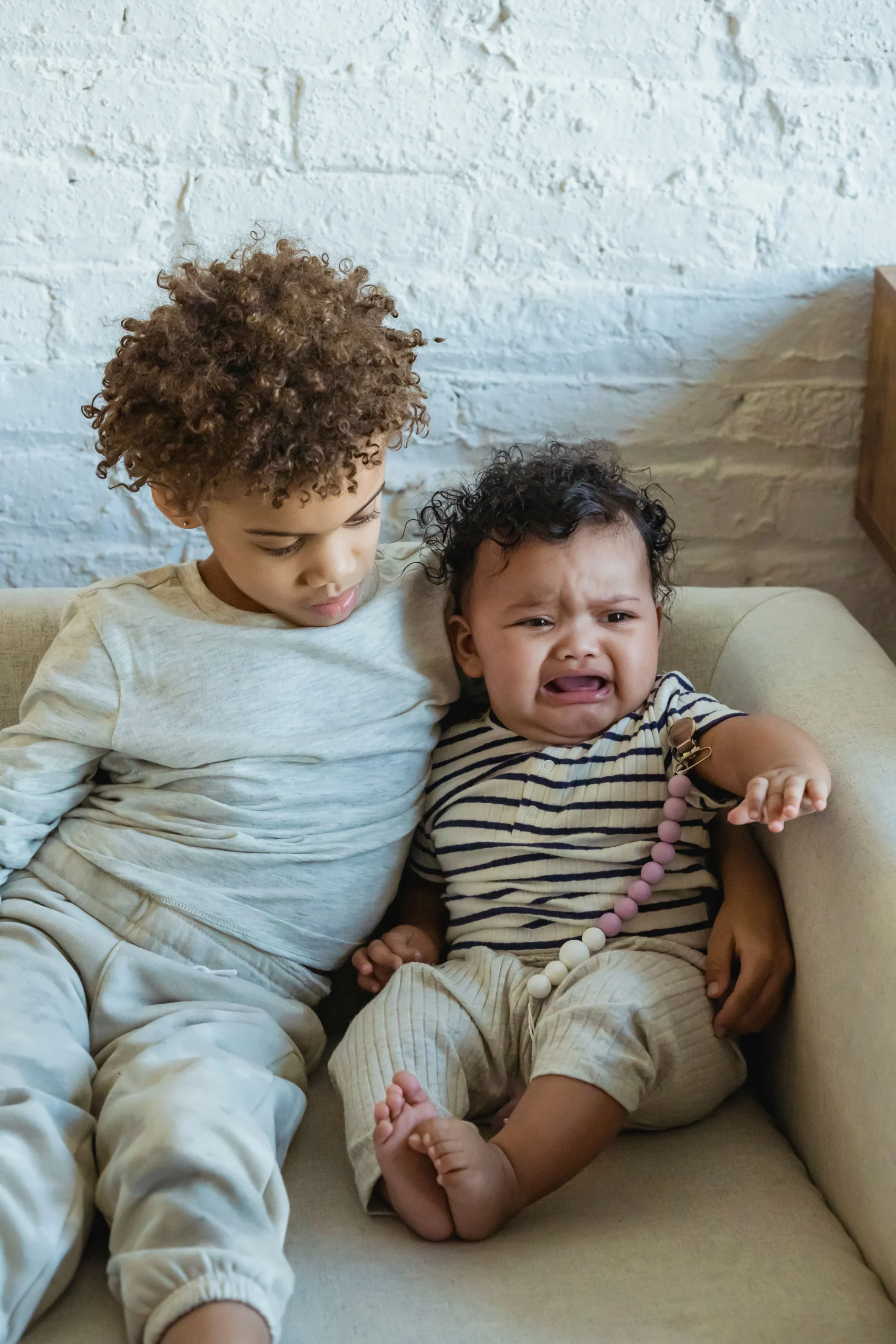
What this article will help you do
If your child keeps hitting their brother or sister, this article gives you a practical starting plan. You will learn what to do today, how to choose one repeated sibling-hitting pattern, how to make that pattern safer, and how to teach a better response before the next argument starts.
Quick summary
Sibling conflict is common, but repeated hitting needs a clear plan.
The goal isn’t to solve every sibling problem in one week, but to choose one repeated hitting pattern and make that pattern less repeatable.
A useful first plan is:
- Check whether the situation needs extra support.
- Choose one flashpoint.
- Make that flashpoint easier and safer before it starts.
- Teach one simple phrase or action your child can use instead of hitting.
- Practise it when calm.
- Respond more strongly to the safer behaviour than to the hitting.
- Review what changed after a few days.
Want help choosing the first sibling-hitting pattern to work on? In a free 25-minute Behaviour Clarity Session, we can look at one repeated situation and identify a practical starting point.
For parents, focused on one behaviour in one home routine. No preparation or expectation to buy further support. Book with your name and email; we’ll guide you through consent and brief checks at the start of the call. Session information · Privacy.
Your 5-minute sibling hitting plan
If you need something to use today, start here.
Choose one repeated sibling-hitting situation, not every sibling argument.
For the next few days, use this plan:
- Separate for safety.
Example: “I will not let you hit. You both need space.” - Check the child who was hurt or frightened first.
Example: “Are you okay? Come next to me.” - Keep your words short with the child who hit.
Example: “Hitting is not safe. You can say ‘help’.” - Prompt the safer alternative phrase.
Example: “Help.” “Move back.” “My turn.” “I need space.” - Practise later when calm.
Example: “Next time your brother takes the toy, show me saying ‘help’ before hands come out.” - Make the flashpoint easier before it happens again.
Use more space, shorter turns, a timer, clearer rules, or adult help before the conflict reaches hitting. - Review one small sign of progress.
Did hitting happen less often, stop sooner, or did your child use the safer phrase once?
This isn’t the whole answer, but it gives you a clear starting point.
First: what kind of sibling hitting are you dealing with?
Before trying to stop the hitting, it helps to sort the level of concern.
Not every sibling argument is the same. Some situations are brief and occasional. Others are repeated, one-sided, frightening, or more unsafe.
Use this as a starting guide:
| Level | What it may look like | What to do |
|---|---|---|
| Lower concern | Occasional hitting during a brief argument, no injury, both children recover quickly, no clear fear or targeting | Use the plan below and watch for patterns |
| Clear plan needed | Repeated hitting around the same situations, one child often loses out, you feel like you are constantly refereeing, the pattern is not improving | Pick one flashpoint and actively change the setup, skills, and adult response |
| Extra support required | Injury, fear, one child regularly targeted, a younger or vulnerable sibling at risk, objects used, threats, increasing frequency or intensity, or you feel unable to keep children safe | Prioritise safety and seek appropriate support rather than relying on a general article |
This matters because sibling hitting can be easy to downplay.
It ‘s not helpful to panic over every sibling clash. It’s also unhelpful to dismiss repeated hitting as “just what siblings do” when one child is regularly hurt, frightened, or pushed out of their own space.
A good plan protects both children: the child being hurt needs safety, and the child using hitting needs a safer way to handle the situation.
The main idea: don’t try to stop all sibling conflict first
Most parents want the whole pattern to stop immediately.
That’s understandable.
But “stop my children fighting” is usually too broad to work on. It includes too many situations, emotions, triggers, and possible responses.
A better starting point is:
Choose one repeated sibling-hitting flashpoint.
For example:
- hitting when a brother takes a toy
- hitting when a sister copies or follows
- hitting during screen-time turns
- hitting in the car
- hitting on the sofa when space is tight
- hitting when one child interrupts another child’s play
- hitting when one child gets adult attention
- hitting during bedtime or morning routines
This isn’t ignoring the other problems. It just makes the first change manageable.
When one pattern becomes clearer, your response becomes clearer too.
Fill in your sibling hitting mini-plan
Use this before the next flashpoint.
The hitting pattern we are starting with is:
Example: hitting when his sister touches his Lego after school.
The safer phrase or action we will teach is:
Example: “Help please” or “Move back.”
I will make the setup easier by:
Example: using a Lego tray, giving protected build space, or staying nearby for the first 10 minutes after school.
When hitting happens, I will say:
Example: “I will not let you hit. Move back.”
I will check the hurt child by saying:
Example: “Are you okay? Come next to me.”
When my child uses the safer phrase, I will respond by:
Example: “You said help. I am coming.”
I will review progress on:
Example: Friday evening.
Keep this plan small. A small plan you can actually use is better than a perfect plan that disappears in the first argument.
The 7-day sibling hitting reset plan
This plan is not a magic fix, but it’s a structured starting point.
Use it when the hitting is repeated but not at a level where urgent or specialist support is needed.
The aim is to make one repeated sibling-hitting pattern safer, clearer, and less rewarding for hitting.
Day 0: Make a safety plan before the next incident
Do this before the next argument starts.
When sibling hitting happens, most parents end up improvising. That’s when it becomes easy to shout, lecture, ask too many questions, or give all the attention to the child who hit.
A simple safety plan reduces that.
Write down three things.
1. Where will each child go to create space?
For example:
- one child moves to the sofa
- one child moves to the kitchen table
- one child stands next to you
- one child goes to a calm agreed space
- the younger child moves behind you
- both children sit apart
This is not a punishment. It’s space.
Use language such as:
“You both need space.”
“I am moving between you.”
“I will help when bodies are safe.”
2. What will you say?
Choose one short sentence.
For example:
“I will not let you hit.”
“Move back.”
“Hands down.”
“You need space.”
“I will listen when everyone is safe.”
Do not prepare a speech. Prepare one line.
3. Who gets attention first?
If one child is hurt or frightened, check them first.
That shows the hurt child that they are protected. It also reduces the chance that hitting becomes the quickest way to take over the room.
You can still return to the child who hit. But in the first moment, safety and protection come first.
A simple response might be:
“I am checking your sister first. I will come back to you when everyone is safe.”
Day 1: Choose one flashpoint
Today’s job is not to fix everything. It’s to choose the first pattern.
Pick one situation where sibling hitting happens often enough to observe.
A good first flashpoint is one that:
- happens several times a week
- has a fairly predictable setup
- causes real strain
- feels possible to change
- does not require solving the whole family routine
Examples:
“Hitting when his brother takes Lego.”
“Hitting when she is copied.”
“Hitting during tablet turn-taking.”
“Hitting in the back of the car.”
“Hitting when they are both on the sofa before dinner.”
Try not to choose a huge target like:
“Sibling aggression.”
That’s too broad.
Choose:
“Hitting when his sister touches his toys after school.”
That’s specific enough to work with.
Day 2: Write the pattern in plain words
Use a simple before-during-after note.
You don’t need a perfect chart. You need useful clues.
| Question | Example |
| What usually happens before? | His sister touches his Lego while he is building |
| What does the hitting look like? | He pushes her shoulder or hits her arm |
| What usually happens after? | She drops the Lego, cries, I rush over, he keeps the Lego |
| What might hitting be changing? | It gets the toy back and gets adult attention fast |
This is where the plan starts to become clearer.
Sibling hitting often does something practical in the moment. It may get a toy back, protect space, stop irritation, delay a demand, bring adult help, or end a situation your child cannot manage.
That does not excuse the hitting.
It shows what the safer replacement needs to do.
If the hitting gets a toy back, your child needs a safer way to protect a turn.
If the hitting gets space, your child needs a safer way to ask for space.
If the hitting brings adult help, your child needs a faster way to call for help before hitting.
Day 3: Change the setup before the hitting starts
This is often the most powerful step.
Many parents focus on what consequence to use after hitting. But if the same setup keeps creating the same conflict, the pattern is likely to keep returning.
Ask:
How can I make this flashpoint less likely to lead to hitting?
If the pattern is about toys
Try:
- clearer ownership rules
- a “finished with it” basket
- shorter turns
- timer-supported turns
- duplicate low-cost high-conflict items where possible
- a rule that new builds or projects have a protected space
- adult help before the conflict reaches grabbing or hitting
Example:
“Lego builds stay on the tray. If you want a piece, ask first or come to me.”
If the pattern is about being copied or followed
Try:
- giving each child a defined space
- teaching “I need space”
- giving the other child a separate job or activity
- having a clear “do not follow” rule for specific moments
- noticing early irritation before it becomes contact
Example:
“If you want space, say ‘space please’ and move to the cushion. I will help.”
If the pattern is about screen turns
Try:
- a visible timer
- clear turn order
- a short warning before turns change
- a neutral place for the device
- something planned for the waiting child
- no negotiating once hitting starts
Example:
“Five minutes each. Timer rings, tablet goes on the table, next turn starts.”
If the pattern is about crowding
Try:
- increasing physical space
- separate seats
- fewer shared blankets or cushions
- adult positioning between children at known high-risk times
- reducing tired, hungry, unstructured time
Example:
“You can both watch, but you need separate cushions.”
This is not “giving in”.
It’s changing the conditions that keep setting up the same behaviour.
Day 4: Teach one safer response
Choose one replacement response only.
Not five. Not a whole social-skills curriculum. One.
The replacement should match the job the hitting was doing.
| If hitting seems to be used to… | Teach this instead |
| Get a toy back | “My turn” / “Can I have it back?” / bring the toy to you |
| Stop a sibling coming close | “Move back” / “I need space” |
| Get adult help | “Help please” / help card / come to parent |
| Stop being copied | “Stop copying” / “I need a different game” |
| Keep a turn | “I am still using it” |
| Cope with losing | “Can I try again?” / “I need a minute” |
| Stop irritation | “Please stop” / move to agreed space |
The phrase needs to be short enough to use under pressure.
A child who is already at the point of hitting is unlikely to say:
“Excuse me, I feel frustrated because my personal boundaries are being violated.”
They might manage:
“Move back.”
“Help.”
“My turn.”
“Space.”
That’s enough to start.
Day 5: Practise before the next argument
This is the part many plans miss.
Children often cannot use a new skill in the middle of an argument if they have only been told about it once.
Practise when calm.
Keep it short and almost boring.
Practice script: toy grabbing
Parent: “Pretend your brother takes the car. What can you say?”
Child: “My turn.”
Parent: “Good. Show me bringing it to me instead of hitting.”
Child brings toy or points.
Parent: “That is the safer way. If you say ‘my turn’ or bring it to me, I will help.”
Practise once or twice. Stop before it becomes annoying.
Practice script: needing space
Parent: “Pretend your sister is too close. What can you say?”
Child: “Move back.”
Parent: “Good. Now show me moving to the cushion.”
Child moves.
Parent: “That tells me you need space. I can help with that.”
Practice script: getting help
Parent: “Pretend your brother will not stop. What can you do before hitting?”
Child: “Help.”
Parent: “Yes. Come to me and say help. I will come with you.”
This practice matters because the aim isn’t just to stop hitting, but to build a usable alternative.
If you can see the pattern but are unsure which skill to teach first, the free 25-minute Behaviour Clarity Session can help you turn what you have noticed into one manageable next step.
Day 6: Change your attention pattern
This step is delicate but important.
When hitting happens, it often pulls adults in quickly. That’s normal. You have to respond.
But if hitting gets the biggest, longest, most intense response, while safer communication is barely noticed, the pattern may not change.
Try this response order.
1. Safety first
Move between children or create space.
Use one short line:
“I will not let you hit.”
2. Check the hurt child
Keep it calm and protective:
“Are you hurt? Come next to me.”
“You are safe. I’m helping.”
3. Briefly return to the child who hit
Keep the boundary clear:
“Hitting is not safe. You can say ‘help’.”
4. Give more attention to the safer response
As soon as your child uses the replacement, respond clearly:
“You said help. I am coming.”
“You moved back. That was safer.”
“You used ‘my turn’. I can help you sort the turn.”
The key is not to ignore hitting. The key is to make the safer behaviour more useful than hitting.
Day 7: Review what changed
After a few days, do a short review.
Don’t ask, “Is the whole sibling problem solved?”
Ask better questions:
- Did the same flashpoint happen?
- Did hitting happen less often?
- Did hitting become less intense?
- Did it stop sooner?
- Did your child use the replacement phrase at least once?
- Did the hurt child seem more protected?
- Did you respond with fewer words?
- Did the setup change make the situation easier?
- What still triggered the pattern?
Look for small signs of progress.
For example:
“He still got upset when his brother touched the Lego, but he said ‘help’ once before pushing.”
That matters.
Or:
“She still shouted when copied, but she moved to the cushion instead of hitting.”
That matters too.
Early progress often looks like a small pause before the old behaviour, one safer phrase, a shorter incident, or a quicker recovery.
Those are not tiny things. They are the beginning of a new pattern.
What progress may look like
Parents often expect success to mean the hitting disappears completely.
That may happen, but early progress is usually smaller.
Look for signs such as:
- the hitting happens less often
- the hitting is less intense
- your child pauses before hitting
- your child uses the safer phrase once
- your child moves away sooner
- the hurt sibling comes to you sooner
- the argument ends faster
- you use fewer words
- you recover faster as a family
- the flashpoint becomes more predictable
These are signs that the pattern may be starting to shift.
A useful first goal is not:
“No sibling conflict ever.”
A better first goal is:
“In this one situation, we know what to do, and it is becoming a little safer.”
What to do for the child being hit
I have seen a child become noticeably more guarded around a sibling—protecting their belongings, holding back and appearing less able to relax during shared activities. In one situation, rebuilding that sense of safety meant arranging short, supported periods together with a parent, grandparent or another familiar adult present. That adult acted as a bridge between the children: facilitating the interaction, helping with turns and stepping in early when needed.
Over time, the child who had more often been hurt began to relax and express themselves more freely because the interaction felt safer and more predictable. It was a gradual process. As siblings grow older, age-appropriate explanations about differences in development, communication and coping may also help build understanding. However, that understanding should never make the child responsible for managing their sibling’s behaviour—the responsibility for safety remains with the adults.
This deserves its own section because the hurt sibling can get lost in behaviour plans.
The aim isn’t only to reduce the hitting child’s behaviour. The aim is also to help the brother or sister feel protected.
Do not make the hurt child responsible for managing the hitting
Avoid putting too much responsibility on the child being hit.
Be careful with phrases such as:
“Just ignore him.”
“Do not wind her up.”
“You know what he is like.”
“Stay out of her way.”
Sometimes siblings do provoke each other. That can be part of the pattern. But the child being hit should not feel responsible for keeping themselves safe from repeated hitting.
A better message is:
“You do not have to be hit. I will help keep space.”
Give them a simple help route
Teach the hurt or targeted child what to do too.
For example:
“Move back and call me.”
“Bring the toy to me.”
“Say, ‘I need help’.”
“Stand behind me.”
This is not about making them solve the problem. It’s about giving them a safe route to adult help.
Repair should not be rushed
If one child has been hurt, do not rush them into accepting an apology.
Repair matters, but forced repair can feel unfair if the child is still upset.
You might say:
“Your brother is not ready for sorry yet. First we are making sure everyone is safe.”
Later:
“Now we can check what needs to happen to repair this.”
Repair might include:
- checking if the sibling is okay
- giving space
- helping rebuild something
- returning an item
- practising the safer phrase
- agreeing what will happen next time
The apology is only one part.
What to say instead of “stop fighting”
“Stop fighting” is understandable, but it’s often too vague.
Children usually need clearer instructions.
Try matching the words to the situation.
| Situation | Instead of saying only “stop fighting” |
| Children are too close | “Move apart. One on the sofa, one by the table.” |
| One child grabs | “Hands off. Ask for a turn.” |
| One child hits | “I will not let you hit. Move back.” |
| One child is following | “Give space. Stay by the door.” |
| One child wants help | “Say, ‘help please’.” |
| Both are shouting | “Pause. One voice at a time.” |
| A toy is the issue | “Toy on the table. I will help with turns.” |
Clear instructions reduce the amount your child has to work out in the moment.
What if both children are part of the pattern?
Sometimes both children contribute.
One grabs, the other hits.
One follows, the other pushes.
One teases, the other throws.
One shouts, the other blocks the doorway.
This still needs adult support.
“Both were involved” does not mean “no one needs help”.
Try separating the jobs.
Child A may need to learn:
- do not grab
- ask first
- give space
- stop when someone says stop
- get adult help earlier
Child B may need to learn:
- do not hit
- say “move back”
- protect a turn safely
- call for help
- move away before contact
Both children can need teaching. But the hitting still needs a clear boundary.
You might say:
“Your sister should not grab. And I will not let you hit. We are going to practise both parts.”
That is fairer than pretending only one child matters.
What if one child seems to be targeted?
If one child is regularly hit, frightened, cornered, or pushed out of activities, treat the situation more seriously.
Watch for patterns such as:
- one child avoids rooms where the sibling is
- one child gives up toys quickly to prevent hitting
- one child changes their behaviour to stay safe
- one child becomes anxious when the sibling enters
- one child is blamed for “setting them off”
- the same child is usually hurt or intimidated
At that point, the plan needs to focus strongly on protection.
That may include:
- closer supervision
- clearer separation during high-risk times
- protected play space
- adult-led turn-taking
- not leaving them to “sort it out”
- seeking support if the pattern continues or risk increases
A home should not become a place where one child feels they have to manage another child’s behaviour to stay safe.
What if the hitting happens when you are busy?
This is a common pattern.
Sibling hitting often happens when the adult is cooking, working, on the phone, feeding a baby, cleaning, or trying to get ready to leave.
That doesn’t mean you are doing anything wrong. It means the children may be in a high-risk setup with less adult support.
Try planning for the first 10 minutes of the busy period.
For example:
- separate starting activities
- one child at the table, one on the floor
- clear “come to me for help” rule
- timer for turns
- snack before the difficult period
- high-conflict toys put away temporarily
- planned attention before you start the task
A useful line before the busy period is:
“I am cooking for ten minutes. You have separate activities. If there is a problem, say ‘help’ and come to me. Hitting means we separate.”
This makes the expectation clear before the situation becomes difficult.
What if the hitting happens during screen time?
Screen time can create sibling conflict because it involves access, turns, control, stopping, and fairness.
Try reducing the number of decisions children have to negotiate.
Set:
- whose turn it is
- how long the turn lasts
- where the device stays
- what happens when the timer ends
- what the waiting child does
- what happens if hitting starts
Example plan:
“Ten-minute turns. Timer on. Tablet stays on the table. When the timer rings, next turn starts. If hitting happens, the tablet goes away while everyone gets safe.”
Then teach the replacement:
“If you want a turn, say ‘my turn next’ or come to me.”
Do not make the screen return because hitting happened. That risks teaching that hitting is part of accessing the screen.
What if the hitting happens over toys?
Toy conflict often needs clearer structure.
Try this:
1. Protect active play
If your child is building, drawing, or setting up a game, create a rule:
“If someone is still using it, ask first.”
2. Create a help route
Teach:
“Help, I had that.”
“My turn.”
“Can I have it back?”
3. Use a neutral holding place
If both children are grabbing or hitting over the item:
“Toy on the table. I will help with turns.”
This avoids turning the toy into a tug-of-war.
4. Practise the exact moment
When calm:
“Pretend your sister takes the car. Show me what to do before hitting.”
Then praise the safer action.
What if the hitting happens because one child wants space?
Some children hit because they feel crowded, copied, touched, followed, or interrupted.
The skill they may need is not only “gentle hands”.
They may need a clear way to protect personal space.
Teach:
“Move back.”
“I need space.”
“Stop.”
“I am going over here.”
Then make that communication work.
If your child says “space” and the sibling keeps following while nothing changes, hitting may still feel like the only effective option.
You can support the boundary:
“He said he needs space. You need to stay by the table.”
This teaches both children: space can be requested safely, and space requests will be supported.
What not to do if you want the pattern to change
Do not run a courtroom every time
Parents often feel pressure to find out who started it.
Sometimes that matters. But in the hardest moment, a long investigation can keep everyone emotionally involved for longer.
Start with safety. Investigate later if needed.
Do not rely on apologies alone
An apology does not teach what to do next time.
Use:
“Thank you for saying sorry. Now we need to practise what to do instead.”
Do not give all the attention to the hitting
Respond to hitting for safety, but give the bigger teaching response to the safer behaviour.
Do not expect unpractised skills to appear under pressure
If your child has not practised “help”, “move back”, or “my turn” when calm, they are less likely to use it during conflict.
Do not make the hurt child responsible for keeping the peace
Children can learn skills on both sides, but the child being hit should not have to manage the whole pattern alone.
Do not hit back or use physical punishment
Physical punishment is not a safe or recommended response. It can hurt your child, frighten them, increase risk, and raise safeguarding or legal concerns.
It also teaches the opposite of what you are trying to build.
If the goal is safer hands, safer communication, and calmer problem-solving, the adult response needs to point in that direction.
If you feel so overwhelmed that you might hit back, the priority is to create distance, keep everyone safe, and get support. Step back if it is safe to do so, move other children away, use fewer words, and return to teaching once everyone is calmer.
Do not change the plan every day
If the plan changes constantly, children cannot learn the new pattern.
Choose one flashpoint and hold the plan long enough to see whether anything changes.
Need help choosing the next step?
Repeated sibling hitting can involve several triggers, skills and consequences at once. If you would like help making sense of one pattern, book a free 25-minute Behaviour Clarity Session. We will clarify what may be happening and whether the session is suitable for your family.
FAQ
How do I stop my child hitting their brother or sister?
Start by choosing one repeated hitting pattern rather than trying to stop all sibling conflict at once. Create space in the moment, check the hurt child, change the setup around the flashpoint, teach one safer response, practise it when calm, and respond quickly when your child uses it.
Should I separate siblings when hitting happens?
Yes, if hitting has started or looks likely, creating space is usually sensible. Separation does not need to be dramatic or punitive. It can simply mean, “You both need space. One here, one there.” The aim is safety and reset, not shame.
Should I punish my child for hitting their sibling?
A clear boundary is important, but punishment alone rarely teaches the missing skill. If hitting is helping your child get a toy, stop a sibling, gain space, or get adult help, they need a safer way to do that. Focus on safety, consistency, and teaching the replacement response.
What should I do for the child who was hit?
Check them first if they are hurt or upset. Help them feel protected. Do not rush them into accepting an apology. Later, you can teach them a safe help route, such as moving back, calling you, or saying, “I need help.”
What if my child says sorry but then hits again?
That usually means the apology is not enough by itself. Your child may still need a clearer replacement skill. Practise what to do next time in the exact situation where the hitting usually happens.
What if both children are hitting each other?
Both children may need teaching, but the hitting still needs a clear boundary. Look at the pattern carefully. One child may be grabbing, teasing, following, or crowding, while the other responds by hitting. Teach both sides: one child may need to stop or give space, and the other may need to ask for help instead of hitting.
When should I get more support?
Get more support if there is injury, fear, one child is regularly targeted, younger or vulnerable children are at risk, the behaviour is escalating, or you feel unable to keep everyone safe. Also seek support if the pattern continues despite a consistent plan, or if there are concerns about communication, sleep, anxiety, trauma, pain, development, or wider family stress.
What to try first this week
Do not try to fix every sibling problem at once.
Choose one repeated flashpoint.
Write down what usually happens before, what the hitting looks like, and what happens after.
Change the setup before the next flashpoint.
Teach one safer phrase, such as:
“Help.”
“Move back.”
“My turn.”
“I need space.”
Practise it when calm.
Respond quickly when your child uses it.
Review after a few days.
The first goal is not perfect sibling harmony. The first goal is one safer pattern.
When one pattern changes, home can start to feel less like constant refereeing and more like something you can guide.
References
Gerow, S., Hagan-Burke, S., Rispoli, M., Gregori, E., Mason, R., & Ninci, J. (2018). A systematic review of parent-implemented functional communication training for children with ASD. Behavior Modification, 42(3), 335–363.

Gerow, S., Neitzel, J., & Dash, A. (2018). Functional communication training: The strength of evidence across disabilities. Exceptional Children, 85(1), 86–103.

Helander, M., et al. (2024). The efficacy of parent management training with or without involving the child in the treatment among children with clinical levels of disruptive behavior: A meta-analysis. Child Psychiatry & Human Development.

National Institute for Health and Care Excellence. (2013). Antisocial behaviour and conduct disorders in children and young people: Recognition and management (CG158).

Toseeb, U., et al. (2025). An investigation of sibling bullying victimisation across 18 countries. Child Abuse & Neglect.

Tucker, C. J. (2025). Sibling aggression and abuse: Invisible and widespread.

Van Kelecom, E., et al. (2025). Addressing physical and psychological sibling violence: Perspectives from youth care professionals in Belgium. Child Abuse & Neglect.